
Running a Sex Offender Check in Westmoreland County
The Virginia Sex Offender and Crimes Against Minors Registry is the authoritative public search for Westmoreland County registry records. Virginia State Police manages that system. The Westmoreland County Sheriff's Office performs local law-enforcement registration and verification work, but it does not publish a separate county registry. Start with the VSP portal, then use the sheriff or the VSP Registry unit for a question about a person's registration duty or a suspected failure to register.
Prepare a full name and any known alias for a person search. For a place search, confirm the street spelling, town or ZIP code, and county before submitting it. Colonial Beach and Montross can be entered as local terms, while a county filter can broaden the Westmoreland County sex offender check. A result is a lead that must be compared with the displayed photograph, descriptors, offense information, and update status. A shared name alone is not a sound match.
Westmoreland Registry Verification
The Westmoreland County Sheriff's Office is the local point for registration and verification obligations imposed by Virginia law. Registrants should confirm current appointment and location requirements with the office at 175 Polk Street, Montross, VA 22520, by calling 804-493-0106. Research did not verify a special registration fee or dedicated public counter hours. Calling first avoids relying on a schedule that the sheriff has not published.
Westmoreland County Sheriff's Office
175 Polk Street
Montross, VA 22520
804-493-0106
Local registration and verification questions. Confirm the current counter procedure before a visit.
VSP Registry Unit
804-674-2825
sor@vsp.virginia.gov
State registry status, statutory duties, public profile, and notification questions.
The sheriff's official resources page and VSP's statewide materials complement each other. Local staff handle required reporting and checks, while VSP maintains the public-facing statewide record. Neither office should be treated as the clerk for the conviction itself. Questions about the underlying criminal judgment belong with the court named on the profile.
Searching the Virginia Sex Offender and Crimes Against Minors Registry
The VSP registry offers separate name and location routes. Its official registry guidance explains the program and public contacts. The search covers qualifying Virginia registrations, including public Westmoreland County entries authorized for release. A blank result does not prove that no relevant history exists because another jurisdiction, delayed reporting, spelling differences, and restricted information can affect results.
- Open the VSP registry, read its disclaimer, and choose a name or location search.
- Enter a verified spelling or a full street, city, ZIP code, county, and available radius.
- Review the list or map, then compare aliases, photographs, and physical details before matching a person.
- Open the full profile and read the offense, registration, update, and compliance fields in context.
| Field Label | Type | Required | Notes |
|---|---|---|---|
| Last Name | Text | Yes for name route | Try exact and permitted variant spellings. |
| First Name | Text | Route-dependent | Narrows a common surname. |
| Street Address | Text | Location route | Use a valid, correctly spelled address. |
| City / ZIP Code | Text or select | Route-dependent | Use Colonial Beach, Montross, or a five-digit ZIP. |
| County / State | Select | State required | Select Virginia and, when useful, Westmoreland. |
| Radius / Map or List | Select and view | No | Use the choices displayed by the live portal. |
Search controls can change. Use the exact distance options that the live portal displays rather than assuming a fixed radius. Map and list views organize the same public information in different ways, and neither view proves that a listed person is at a precise point at the moment of search.
Note: A Westmoreland County registry search is strongest when name, photograph, descriptors, and profile status all point to the same person.
Westmoreland NSOPW Registry Search
Westmoreland County lies on Virginia's Northern Neck near the Potomac and the Maryland boundary. That geography makes a second official search useful. The U.S. Department of Justice's National Sex Offender Public Website searches participating jurisdictions through one national layer. It supplements the Virginia registry when an address, trip, family activity, or other safety concern crosses state lines.
The official NSOPW page is also the source of the search interface shown here.
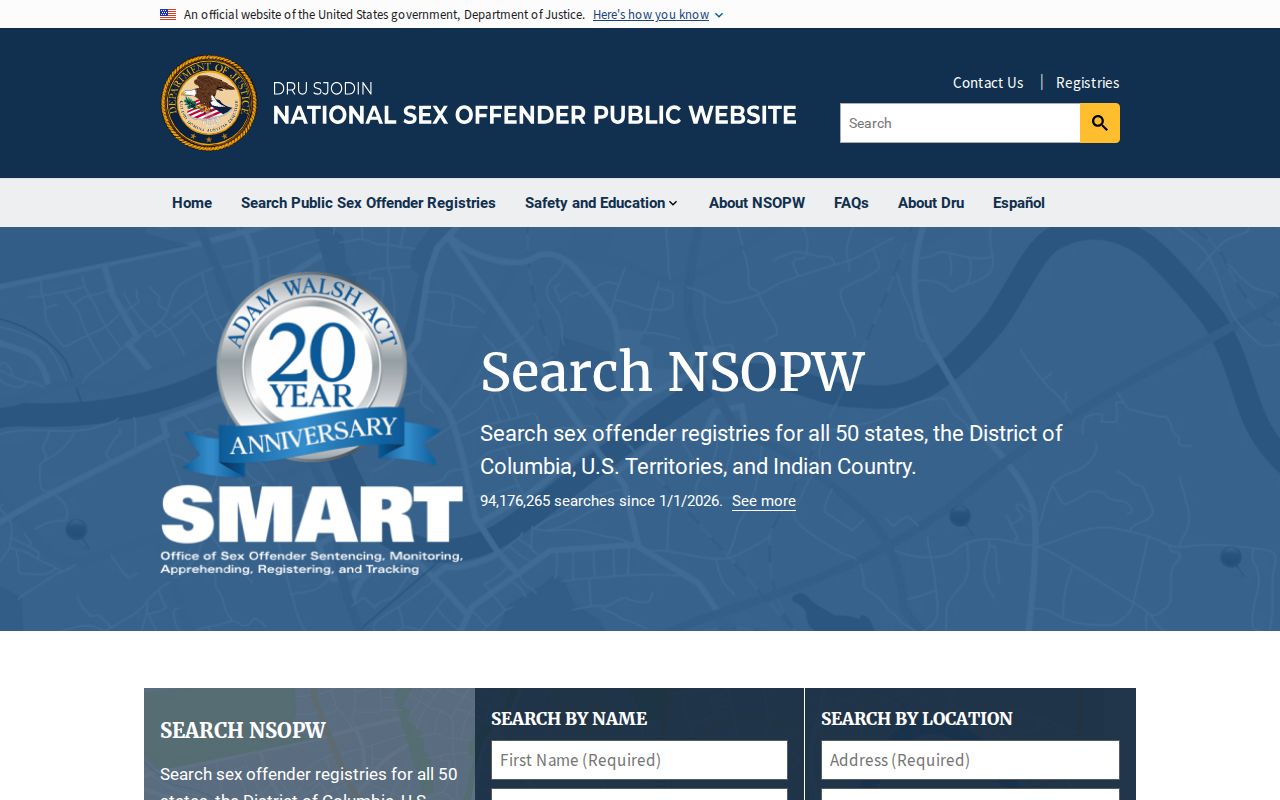
Use NSOPW to widen the geographic check, then open the source-jurisdiction profile for its current details and warnings. Different states publish different fields under their own laws. A national result should therefore route the reader back to the agency that owns the entry, not replace that agency's record.
What a Registry Profile Shows
A public Virginia profile combines identity, conviction, address, and registration data that state law permits VSP to disseminate. Read each field on its own terms. The offense and conviction entries describe a qualifying past judgment. The status and update fields describe the registry record. Neither one is a complete case docket, statewide rap sheet, or prediction of present conduct.
| Name & Aliases | Reported names that help distinguish spelling and identity variants. |
|---|---|
| Photo & Physical Description | A current published photograph plus lawful identifying descriptors. |
| Registered Address | The location detail authorized for public dissemination. |
| Offense & Statute | Offense description, Code section, jurisdiction, and conviction details when populated. |
| Tier / Category | The statutory registration class tied to the qualifying offense and rules. |
| Registration Status | Compliance notices, detail dates, and other registry status information shown by VSP. |
| Other Reported Details | Scars, marks, tattoos, vehicle, work, or school fields only when lawfully displayed. |
A profile can change as VSP receives new information. Read the detail date and any compliance note instead of treating an older screenshot or copied list as current. People who share an address are not part of the listed person's record, and nothing in a profile supports an inference about them.
Westmoreland Registry Map Limits
A pin is a way to orient a location search. It is not a live tracking device and does not guarantee that a person is present at that spot. Address updates can take time to move through local verification and the statewide registry. Street geocoding can also place a marker near, rather than on, an entered address. Check the written address and update fields before drawing a conclusion from the map alone.
A missing pin does not establish that an area is safe. The person may not have a qualifying registration duty, may be registered in another jurisdiction, may appear under another spelling, or may not yet be reflected in the public data. Personal and family safety plans should use the registry as one source, along with sound day-to-day precautions and direct reports of suspicious or threatening conduct.
Note: Report an immediate threat through 911; use the sheriff or VSP Registry unit for a non-emergency compliance concern.
Registration Requirements and Levels in Virginia
Virginia uses three statutory tiers. The qualifying offense and the rules in the Sex Offender and Crimes Against Minors Registry Act determine the tier. A reader should not assign a risk label based on a short offense description. Sections 9.1-902 and 9.1-903 define key duties and classifications, while §§ 9.1-908 and 9.1-910 control duration and removal questions. Amendments and the facts of an individual conviction can affect the answer.
| Tier | General Concept | Duration and Verification |
|---|---|---|
| Tier I | Enumerated qualifying offenses not placed in a higher tier. | Generally the least severe tier; verify current duration and removal rules in the Code. |
| Tier II | Enumerated more serious or repeat qualifying offenses. | Longer registration and more frequent verification when the statute requires it. |
| Tier III | Enumerated most serious offenses and specified repeat conduct. | Lifetime framework and the most frequent verification, subject to the exact provisions. |
Registration commonly calls for prompt in-person action after release or a reportable change, periodic verification, and notice of address or other required changes. The Westmoreland County Sheriff's Office can explain its current registration procedure. VSP should answer questions about the statewide profile. A court or qualified Virginia lawyer is the proper source for case-specific advice about classification or removal.
Westmoreland ZIP Registry Alerts
VSP provides a notification route that is separate from a one-time registry search. Form SP-285 addresses notification of registration or re-registration in the same or a contiguous ZIP Code. A Westmoreland County resident should use the current form, supply the contact and target ZIP information it requests, and follow the live submission instructions. The form is useful for ongoing awareness without repeatedly running the same place search.
Notification does not replace reading the full public profile. An alert reports an event within the program's scope, while the profile supplies the identity, offense, address, and status fields authorized for display. Keep the target ZIP current and review VSP's instructions whenever contact details change.
Correcting Westmoreland Registry Details
If an address or compliance field appears wrong, do not confront the listed person or anyone at the address. Record the public profile details and contact the Westmoreland County Sheriff's Office or the VSP Registry unit. Those agencies can compare the concern with registration and verification records. For an emergency, call 911. For a routine question, use the published sheriff and VSP contacts.
An offense or conviction question takes a different route. The court named in the profile owns the underlying judgment, so its clerk is the source for the case docket or order. For a local felony judgment, the Westmoreland Circuit Court clerk is the official courthouse source. A Westmoreland County criminal case may also be checked through the criminal court case record route, but registry staff remain responsible for the public registry entry.
Westmoreland Registry Versus Criminal History
A registry entry answers a narrow statutory question: whether Virginia publicly lists a person under the Registry Act and what fields it may show. A VSP criminal-history response, by contrast, draws from the Central Criminal Records Exchange under Code § 19.2-389. A court case file shows the charge as prosecuted, hearings, orders, and disposition. The Northern Neck Regional Jail roster answers current custody. These sources overlap, but none is a substitute for the others.
For personal safety and community awareness, begin with the VSP and NSOPW public registry tools. For the judgment behind an entry, use the named court. For review of one's own Virginia criminal history, follow VSP's official SP-167 process. This separation also prevents a profile from being misread as a complete account of every case or as proof of conduct beyond the listed conviction and registry status.
Lawful Use and Community Notification
Virginia publishes designated registry information for protection and awareness under Code § 9.1-912. Lawful use means reading the official profile, planning sensible safety steps, and reporting a genuine compliance concern to the proper agency. It does not authorize a visit to a listed address, contact with occupants, publication of a vigilante list, or claims about people who happen to live nearby.
Registry Misuse Is a Crime: Virginia's Registry Act forbids using public registry information to intimidate, harass, threaten, or commit a crime. Never target a registrant, household member, or address.
Suspected noncompliance should go to the Westmoreland County Sheriff's Office or the VSP Registry unit. Give the agency the profile reference and the fact that caused concern, without circulating an accusation. Questions about statutory reporting duties belong with those agencies. Questions about the conviction itself belong with the court. That route protects both public safety and the accuracy of the official record.